Historic Buildings of Massachusetts

  • About
  • Index by Town
  • CT
  • About
  • Index by Town
  • CT

Month: June 2008

Old State House (1713)
by Dan/June 23, 2008January 19, 2020/Boston, Colonial, Public Buildings

old-state-house-01.jpg

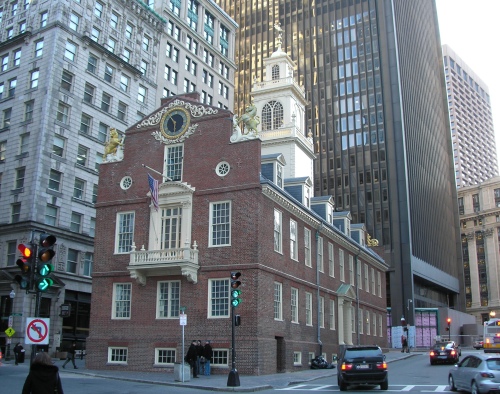
Since the 1630s, what would become the site of the Old State House in Boston was where the Puritans’ stocks and whipping posts were located and where the town’s earliest market was held. A wood Town House was built there in 1657, which had an open air market on the ground floor and a meeting place above. After this structure burned down in 1711, a new brick one was built in 1713, although the interior was gutted by fire in 1747 and had to be restored afterwards. This historic structure at the head of State Street, which became the seat of British Royal government in Massachusetts, was the site of many significant events: James Otis‘ speech against the writs of assistance in 1761; the March 5, 1770 Boston Massacre, which occurred just in front of the building; the first reading for Bostonians of the Declaration of Independence by Col. Thomas Crafts from the east balcony on July 18, 1776 (at which time the people torn down from the building the original royal lion and unicorn to be consigned to a bonfire); and the 1789 visit of President George Washington. After the Revolutionary War, it continued to serve as the State House until 1798, when it was given to the town in exchange for a new State House site on Beacon Hill. In 1830, it was altered by architect Isaiah Rogers in the Classical Revival style to serve as a City Hall until 1841. After that, it began a long decline. Housing offices and shops, the exterior was covered with advertisements. There were thoughts of demolishing it to widen the street and Chicagoans even offered to move it to Illinois! In 1882, it was eventually restored (with replicas of the old lion and unicorn) and rededicated as a museum, run by the Bostonian Society. A more recent restoration was completed by Goody, Clancy & Associates in 1991. The building is part of the Boston Freedom Trail. See below for more pictures of the Old State House:
Continue reading “Old State House (1713)”

Nathaniel Hawthorne Birthplace (1730)

by Dan/June 23, 2008June 29, 2013/Colonial, Houses, Salem

hawthorne-birthplace.jpg

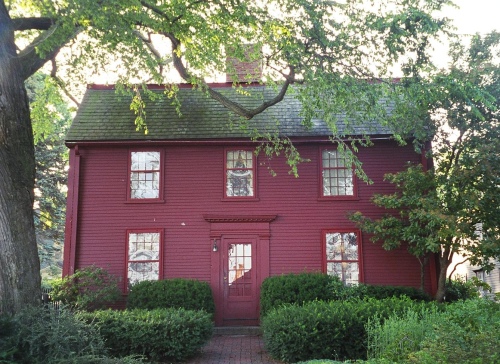
The house in which the author, Nathaniel Hawthorne, was born on July 4, 1804 and lived in until he was age 4 is located in Salem. It was originally on Union Street, but in 1958 it was moved to a site adjacent to the House of the Seven Gables, the building that would inspire Hawthorne to write the novel of the same name. The house was built between 1730 and 1745 for Joshua Pickman, a Boston mariner. It was bought by Hawthorne’s grandfather, the famous shipmaster Captain Daniel Hawthorne, in 1772. As part of the House of the Seven Gables Settlement Association property, the house is now a museum open to visitors.

Concord Town House (1851)

by Dan/June 8, 2008January 16, 2020/Concord, Italianate, Public Buildings

concord-town-house.jpg

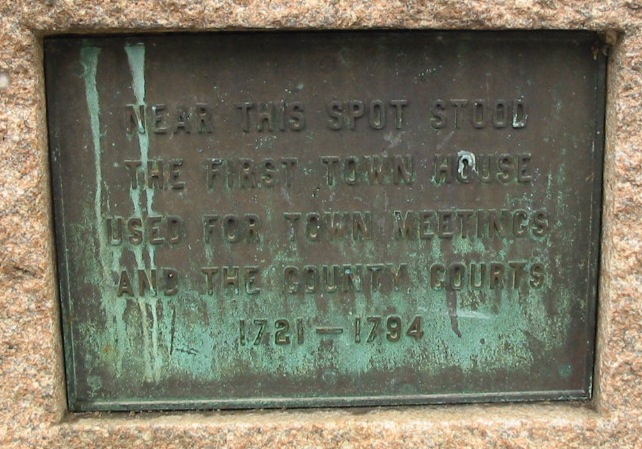
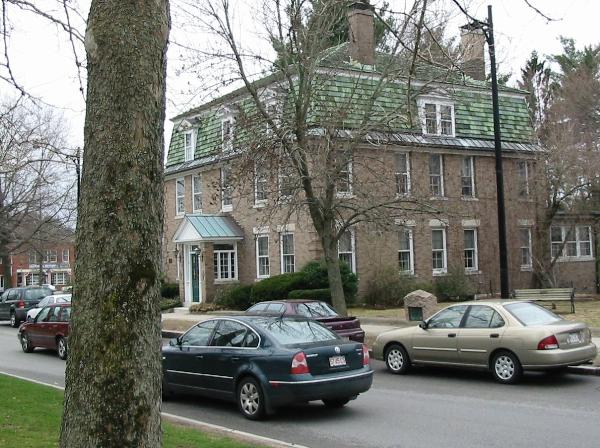
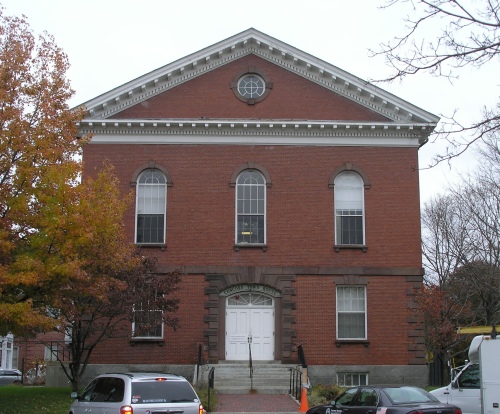
The Town of Concord’s first Town House, used for “town meetings and the county courts 1721-1794,” was located across the town green from the location of the current Town House. In the nineteenth century, the town would continue to share a building with the courts, until a fire destroyed the courthouse in 1849 and the town’s privilege to use it’s replacement was not renewed. A new structure was therefore built specifically for town use in the Italianate style, designed by the Boston architect Richard Bond, who also designed Boston’s Lewis Wharf and Salem’s City Hall. Called a “town house,” it contained not only a town hall, but originally also housed Concord’s first public library and school classrooms. Later, the building would be used for strictly municipal functions. An addition was added to the rear in 1879-80.

Second Harrison Gray Otis House (1802)

by Dan/June 8, 2008September 17, 2016/Boston, Federal, Houses

second-harrison-gray-otis-house.jpg

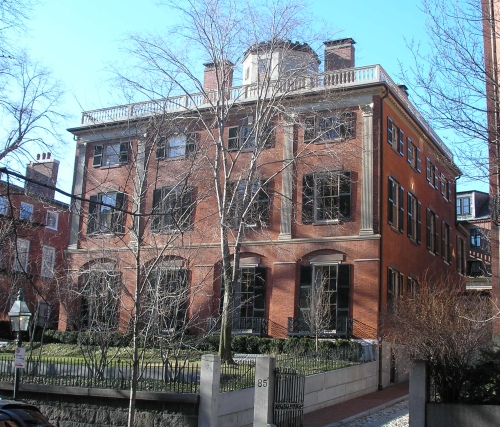
The only freestanding mansion on Boston’s Beacon Hill is the second of three houses designed by Charles Bulfinch for Harrison Gray Otis, a prominent businessman, lawyer and Federalist Party leader. Both Otis and Bulfinch were members of the Mount Vernon Proprietors, who purchased land on Beacon Hill for development. Bulfinch created an even more elegant mansion for Otis on Mount Vernon Street than the one he had created earlier, on Cambridge Street in 1796. Constructed between 1800 and 1802, Bulfinch hoped that the freestanding home on a landscaped property with outbuildings in back would be a model for the rest of Beacon Hill, but the neighborhood would end up being much more densely developed. Otis sold the house in 1806, only a few years after it was built: his growing family would require an even larger home, also to be designed by Bulfinch. Many people have owned the Second Harrison Gray Otis House over the years and undertaken various renovations and remodelings.

Hollis H. Hunnewell House (1869)

by Dan/June 8, 2008September 17, 2016/Boston, Houses, Second Empire

hunnewell-house.jpg

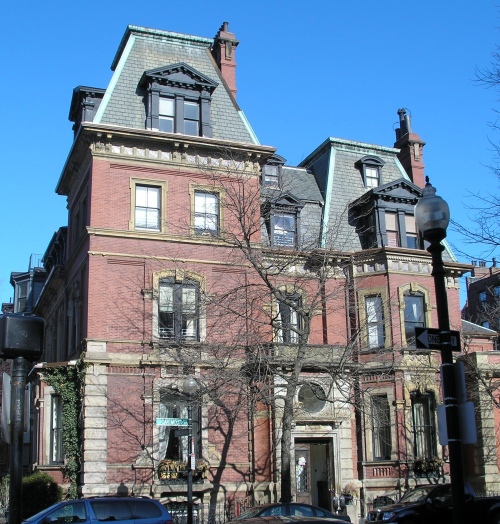
The Hollis H. Hunnewell House, on Dartmouth Street in Boston’s Back Bay, was built in 1869-1870. It was designed by Sturgis and Brigham for Hollis Horatio Hunnewell, son of Horatio Hollis Hunnewell, a wealthy financier, horticulturalist, and great benefactor of the town and college of Wellesley. Sturgis and Brigham designed the house with some of Boston’s earliest ceramic ornamentation on a building’s exterior. The mansard roofs atop the mansion’s irregularly sized towers, as well as a new one-story wing, were added to the building after a fire in 1881. In the early twentieth century, the house was owned by T. Jefferson Coolidge.

Benjamin Wadsworth House (1726)

by Dan/June 8, 2008September 17, 2016/Cambridge, Colonial, Houses

benjamin-wadsworth-house.jpg

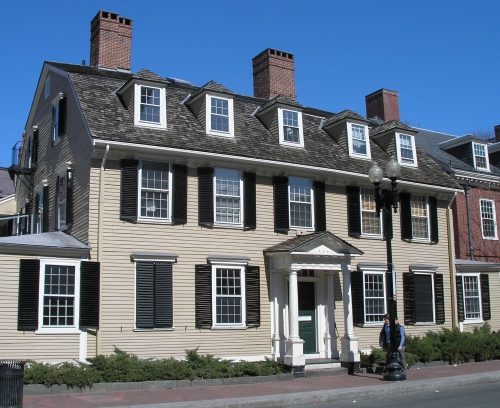
In 1726, a house was constructed on Massachusetts Avenue in Cambridge, on the site where Harvard’s earliest building, the Peyntree House, had stood. It was first occupied by Harvard’s fourth president, Benjamin Wadsworth, his family and two slaves. After Wadsworth, it would serve as the home of eight other presidents, until 1849, when president Jared Sparks chose to reside in his own Cambridge home. During the Revolutionary War, the house was Washington’s first headquarters when he came to command the army during the siege of Boston in 1775. Do to its state of disrepair at the time, Washington soon moved to other quarters. Over the years, the house would serve as lodging for visiting ministers and student boarders (including Ralph Waldo Emerson). The building now houses the Office of the University Marshal and other offices. The Wadsworth House lost its front yard when Massachusetts Avenue was widened. Today it is the second oldest of Harvard’s surviving buildings, after Massachusetts Hall.

John Hodges House (1788)

by Dan/June 8, 2008September 17, 2016/Colonial, Houses, Salem

john-hodges-house.jpg

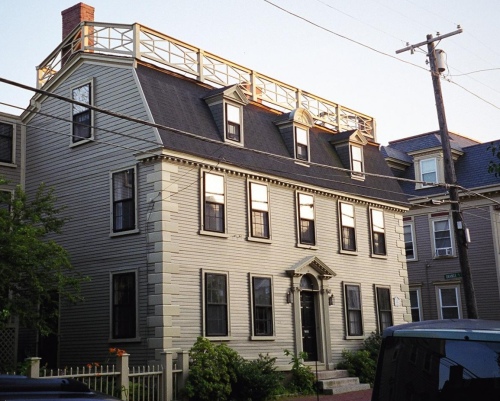
Built around 1788 on Essex Street in Salem, the John Hodges House is late Georgian-style home with a grand spiral staircase within. Hodges was a merchant and passed the house on to his son, Benjamin Hodges, after it was built.

Privacy Policy

Categories

  • Architectural Style (943)
    • Art Deco (9)
    • Byzantine (3)
    • Colonial (177)
    • Colonial Revival (85)
    • Craftsman (6)
    • Egyptian Revival (1)
    • Federal (190)
    • Foursquare (6)
    • Gothic (67)
    • Greek Revival (100)
    • Italianate (82)
    • Mission Revival (2)
    • Mission/Spanish Colonial (1)
    • Modern (2)
    • Neoclassical (56)
    • Octagon (3)
    • Postmodern (1)
    • Queen Anne (46)
    • Renaissance Revival (26)
    • Romanesque Revival (53)
    • Second Empire (26)
    • Shingle Style (12)
    • Stick Style (13)
    • Tudor Revival (8)
    • Vernacular (49)
    • Victorian Eclectic (15)
  • Building Type (943)
    • Apartment Buildings (8)
    • Banks (18)
    • Churches (119)
    • Collegiate (32)
    • Commercial (102)
    • Hotels (16)
    • Houses (508)
    • Industrial (23)
    • Libraries (22)
    • Lighthouses (1)
    • Military (15)
    • Monuments (1)
    • Museums (12)
    • Organizations (39)
    • Outbuildings (17)
    • Public Buildings (50)
    • Schools (23)
    • Stations (5)
    • Synagogues (1)
    • Taverns (21)
    • Theaters (9)
  • Town (943)
    • Adams (11)
    • Agawam (4)
    • Amherst (50)
    • Boston (64)
    • Boylston (6)
    • Cambridge (30)
    • Clinton (21)
    • Concord (15)
    • Cummington (1)
    • Danvers (14)
    • Deerfield (31)
    • Gloucester (18)
    • Granville (10)
    • Great Barrington (2)
    • Hadley (9)
    • Hancock (15)
    • Harvard (32)
    • Holyoke (47)
    • Lenox (5)
    • Lexington (8)
    • Longmeadow (32)
    • Marblehead (40)
    • Marlborough (4)
    • Natick (22)
    • Newton (2)
    • Northampton (68)
    • Peabody (4)
    • Pittsfield (20)
    • Salem (110)
    • Saugus (4)
    • Sheffield (4)
    • South Hadley (8)
    • Southborough (8)
    • Southwick (4)
    • Springfield (67)
    • Stockbridge (19)
    • Stow (1)
    • Sturbridge (18)
    • Sudbury (7)
    • Waltham (11)
    • Watertown (1)
    • Wayland (8)
    • West Springfield (14)
    • Westfield (46)
    • Weston (2)
    • Worcester (26)
  • Uncategorized (1)

Recent Comments

  • Wilber Blackson on South Hadley
  • Tami Speiden on Stockbridge
  • DexGuru on Stockbridge

Tags

Alcott Amherst College Asher Benjamin Back Bay Baptist Beacon Hill Big E Black Heritage Trail bowfront Bulfinch Catholic Congregational Episcopal Freedom Trail Gambrel H.H. Richardson Harvard Hawthorne Historic Deerfield Isaac Damon lit Longfellow mansard Methodist Mount Holyoke Museum Museums NPS Old Sturbridge Village PEM Revolutionary War row houses saltbox Samuel McIntire Shakers Smith College SPNEA Springfield Armory Stephen C. Earle Storrowton Underground Railroad UU Washington William Fenno Pratt Witch Trials

Meta

  • Log in
  • Entries feed
  • Comments feed
  • WordPress.org
Proudly powered by WordPress | Theme: ShowMe by NEThemes.