Category Archives: Colonial Revival

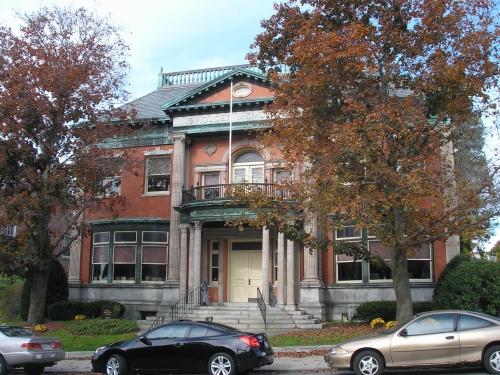
Ransom F. Taylor House (1907)

The house at 6 Oak Street in Worcester was built in 1906-1907. It was the home of Ransom F. Taylor, son of Ransom C. Taylor (d.1910), a wealthy real estate developer who became Worcester’s largest property owner. According to Historic Homes and Institutions and Genealogical and Personal Memoirs of Worcester County, Massachusetts, Vol. II (1907), Ransom Frederick Taylor

was born in Worcester[.] He married Virginia Byrd Chapman, of York, Pennsylvania. He was educated at the Highland Military Academy, Worcester, and Phillips Andover Academy. He has for a number of years been associated with his father in business and has shared the management of his property largely. In recent years he himself has been a large investor in real estate and is accounted as one of the shrewdest and most accurate judges of the values of real estate in the city.

The house was purchased by Becker College in 1955 and is now a dormitory called Merrill Hall, named for civic leader and trustee of the college, Everett E. Merrill.

Share Button
Posted in Colonial Revival, Houses, Worcester | Tagged | 1 Comment

John M. Cook House (1884)

Transitional in style between the Queen Anne/Shingle style and the Colonial Revival, the house at 120 Main Street in Lenox was built in 1884 by John M. Cook, a farmer and manager for E.J. Woolsey. He sold the house in 1886 and it became known as “The Willows,” a property rented out to summer visitors. In 1905 it was purchased by Father William F. Grace and in 1912 became the rectory for St. Ann Catholic Church. Later in the twentieth century, the house was sold and is now home to Roche Funeral Home.

Share Button
Posted in Colonial Revival, Houses, Lenox, Shingle Style | Leave a comment

Tilton Library (1916)

The Village Library Association was founded in South Deerfield in 1871 and in 1893 it became the South Deerfield Village Library, supported by town funds. The library had several homes, moving from a room in a private building to a newly erected room in the Congregational Chapel in 1876, it moved again in 1906 to the ground floor of Tilton’s Grocery Store. Chauncey B. Tilton, a local grocer, had died in 1900. The Supreme Court of Massachusetts later ruled that money he had left for charitable purposes could be used for literary or educational purposes. This enabled the construction of Tilton Library, built in 1915-1916 as a permanent home for the South Deerfield Village Library. In the late twentieth century, Tilton Library merged with Old Deerfield’s Dickinson Library to become the town of Deerfield’s public library.

Share Button
Posted in Colonial Revival, Deerfield, Libraries, Neoclassical | Leave a comment

F.W. Lathrop House (1899)

F.W. Lathrop was a Springfield real estate dealer. In 1899, he supervised the construction of his own house at 188 Sumner Street from plans executed by Carroll H. Pratt, who was the assistant of architect Louis Frank Newman. The house has an American Foursquare form with Colonial Revival and Neoclassical architectural features. The house later became the first home of Sinai Temple, which moved to a new building at 1100 Dickinson Street in 1950. The house was next home to Lubavitcher Yeshiva Academy and then to an artist who ran “The Mansion House” art school in his home. For 17 years the house was owned by the Griffin family and most recently by an owner who in 2003 opened a bed-and-breakfast in the house called the Lathrop House B&B, which closed last year.

Share Button
Posted in Colonial Revival, Foursquare, Houses, Neoclassical, Springfield | Leave a comment

Chesterwood: The House (1901)

In 1896, sculptor Daniel Chester French purchased the Warner farm in Stockbridge. Naming his new estate Chesterwood, he soon built his studio next to the C. 1820 farmhouse. In 1901 French replaced the farmhouse with a new Georgian Revival residence designed by Henry Bacon. Like the studio, also designed by Bacon, the house is covered with stucco that is studded with marble and coal chips. The sitting room is a replica of the Best Parlor in the French family homestead in Chester, New Hampshire. Chesterwood was inherited by French’s daughter, Margaret French Cresson (1889-1973), who was also a sculptor. She donated Chesterwood to the National Trust for Historic Preservation. (more…)

Share Button
Posted in Colonial Revival, Houses, Stockbridge | Tagged | Leave a comment

Chesterwood: The Studio (1897)

Chesterwood is the 122-acre estate that was once the summer home of sculptor Daniel Chester French (1850–1931). French is famous for such sculptures as the Minuteman in Concord and the seated Abraham Lincoln in the Lincoln Memorial in Washington, DC. Chesterwood, located in Stockbridge, is now owned by the National Trust for Historic preservation and is open to the public. In 1896, French purchased the farm of Marshall Warner. The following year, he moved the Warner barn, adjacent to the Warner House, to make way for his new studio. Designed by Henry Bacon (architect of the Lincoln Memorial), the Studio has a workroom, a reception area with a piano and a 50-foot veranda. The wooden frame building is covered with stucco in which marble and coal chips were mixed to provide texture. So that French could work on his pieces in natural light, the workroom has 30-foot high double doors through which sculptures could be brought outside on a flatcar along a short railway track. (more…)

Share Button
Posted in Colonial Revival, Outbuildings, Stockbridge | Tagged | Leave a comment

Wheatland-Phillips House (1896)

The Wheatland-Philips House is a Colonial Revival-style residence, built in 1896 at 30 Chestnut Street in Salem. It was designed by architect John P. Benson for for Mrs. Stephen G. Wheatland and has since been owned by the Pickering and Phillips families.

Share Button
Posted in Colonial Revival, Houses, Salem | 1 Comment